

Bastard Baguettes
but let's try to enjoy ourselves for once
Warning, this is a sort of technical post.
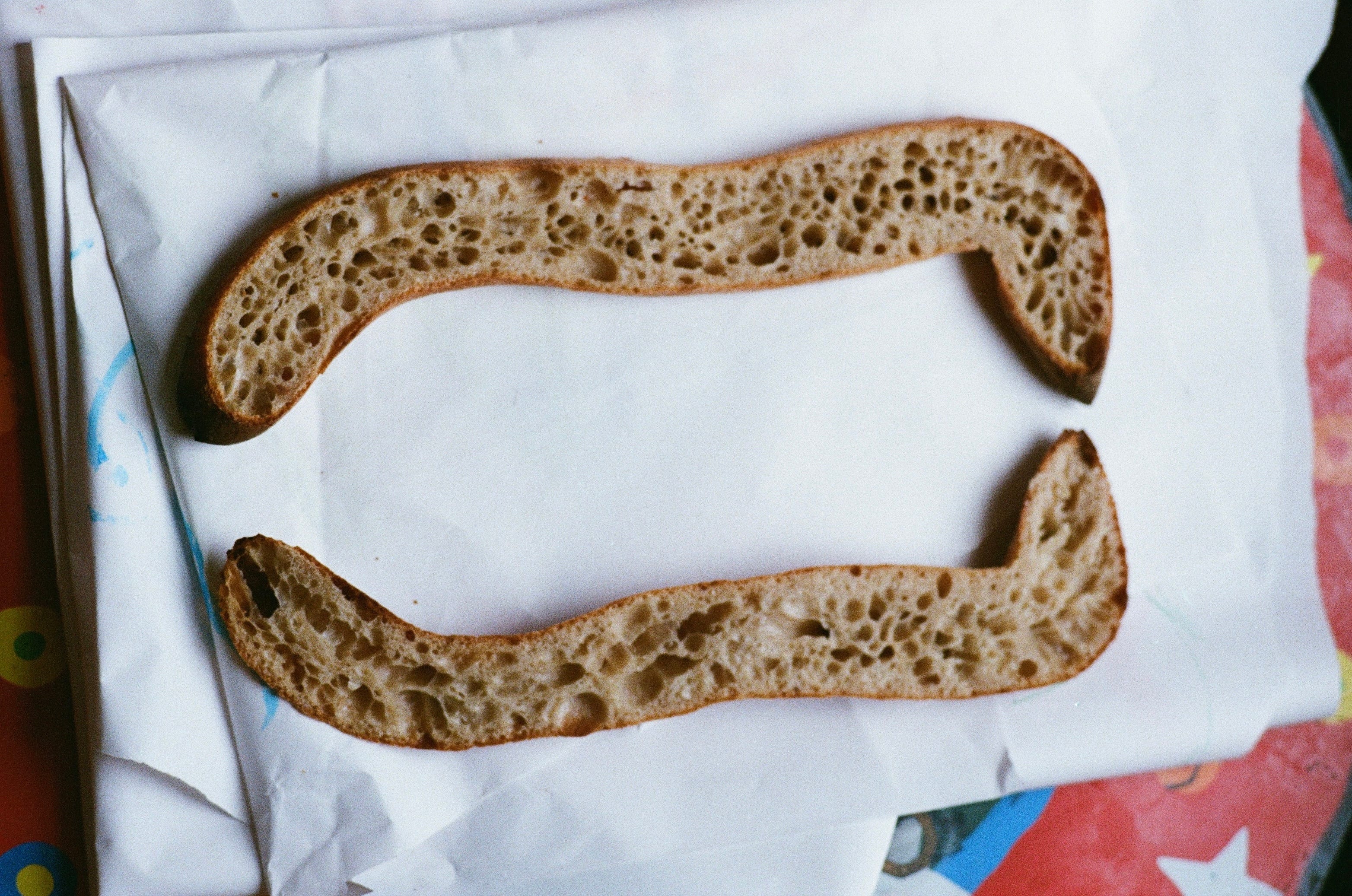
I had this idea for a recipe in the book called Bastard Baguettes that went something like: here are breads that have proliferated all over the world, have been adopted and bastardized by those they’ve been imposed on, by the subaltern I guess, well beyond the confines of their French homeland. They were brought to these places through conquest mostly but have been given new life, transformed into things like tapalapa, bánh mi, aish fino, francala, and are still made and called baguettes in places like Tunisia, Algeria, Morocco, Gabon, and Haiti. Even so, it’s impossible to entirely outrun the stink of an imperial past, so they are largely bastards already if they’re not made tidily at home, where strict guidelines keep them in place. With such a profusion of bastardizations already in play (and who is to blame for it?), I think you should just do whatever you want to them, unshackle yourself from their aesthetic rigidity, fuck them up, because there are enough attempts at perfect baguettes already, and they also happen to be really difficult to reproduce at home, precisely because they were not invented to be made there but in boulangeries; also they stale quickly, and who really needs a baguette anyway when we have so many other breads with more meat on their bones, and don’t they represent a trite and shallow ideal? And don’t they epitomize the pallid phallic virus of the colonial worldview?
I’m juicing it up for you but that was the gist. But in order to break baguettes down I first had to make perfect ones in my kitchen. I don’t work in a professional setting anymore, I test all my recipes from my studio and home kitchen so that they accurately reflect the experience of the home baker (I last made baguettes regularly for a couple years in a bakery in Austin, TX in the early 2010s). As I embarked on this journey without the niceties of a walk-in fridge and steam-injected oven, I faced many an annoying challenge, worked through iteration after iteration of formula and process, took pages of notes, made many croutons, got some steam burns, all to realize that upon reaching a technical apogee - which, I must say, I feel I have - not only do I not want to forsake the perfect baguette, but I actually want to eat them all the time, more than I want to eat many other breads, and I find the qualities that traditionally define them - the ratio of crust to crumb, a thin crisp shell around a cobwebby but still spongey interior, even their demonic baton-like form - lovable and worth saving.
They can be such a pain in the ass. I am, like in my last post, dismayed by my affection for a bread that I’d written into a bad character. I think this is what happens when a narrative informs craft, and why more and more these days I’m tempted to place the historical context next to the object or material or whatever, not on top of it, and try to appreciate a thing for the characteristics I myself can experience. Life is hard enough, we should be able to appreciate something good for its plain goodness.
Here are 16 things I’ve learned about making good baguettes anywhere, but in particular at home:
The baguettes need to be slightly underproofed. I remember coming to this realization while working in the bakery over a decade ago, where I made hundreds of baguettes as one of my first tasks as a professional baker. I believe in pushing to the edge of overproofed for most other breads, but baguettes should be baked young, otherwise they’ll lack volume and the interior will be dense.
The bulk fermentation should be quick, too. Whereas I’d normally bulk ferment a dough like this for 2 or 3 hours, this one gets a single fold after 30 mins, then another 30 min rest, and then into the fridge. This saves lots of energy in the dough for the proof and bake.
Hydration is less important than fermentation, but it can be higher than you think (I make mine at around 77% hydration) without making shaping too difficult, so long as the dough is well-developed and given time to rest before shaping.
A tiny bit of yeast is a tool not a cheat, and when combined with a ripe sourdough it goes a long way in achieving that milky, webby crumb. I use less than 1%.
The dough should have grown to about 1.5x its volume between the end of bulk and preshaping. This has been the sweet spot for adequate fermentation and enough reserved power for a nice oven bloom.
A long preshape - I do a whole hour - is a good way to give the dough a final push of fermentation while making the pieces very easy to shape and keeping the shaped loaves spry for the bake.
I find a small round works just as well or better than a little tube when preshaping. It’s faster and requires basically no flour to achieve, and results in a naturally tapered cylinder when shaping.
Shaping is just about folding, tucking, and rolling. Go slow, make batches a few days in a row so you get a lot of practice in quick succession. This is about muscle memory.
Get your setup dialed in. This goes for shaping, proofing, chilling, and baking. Have everything you need at hand. For shaping, I do the same thing every time - I dust the countertop in a horizontal line right over the area I’m shaping in, about a foot away from me on the countertop. I use something like this. Then I flip a round into it quickly with the help of my bench knife, and swipe my dough through it as needed throughout the shaping process (again, using my bench knife to lift it from the counter). I have my couche well-floured and laid out nearby on a large cutting board or sheet tray. If I’m using cotton kitchen towels instead of linen, I’ve generously dusted those with all-purpose or whole wheat flour and rice flour.
Don’t shape more than you can bake in one or two oven loads or you’re at risk of overproofing.
Put the shaped breads in the fridge for an hour after their room temp proof. They’ll be so much easier to transfer and score, and their firmness will make it less likely you’ll compress the interior structure when scoring.
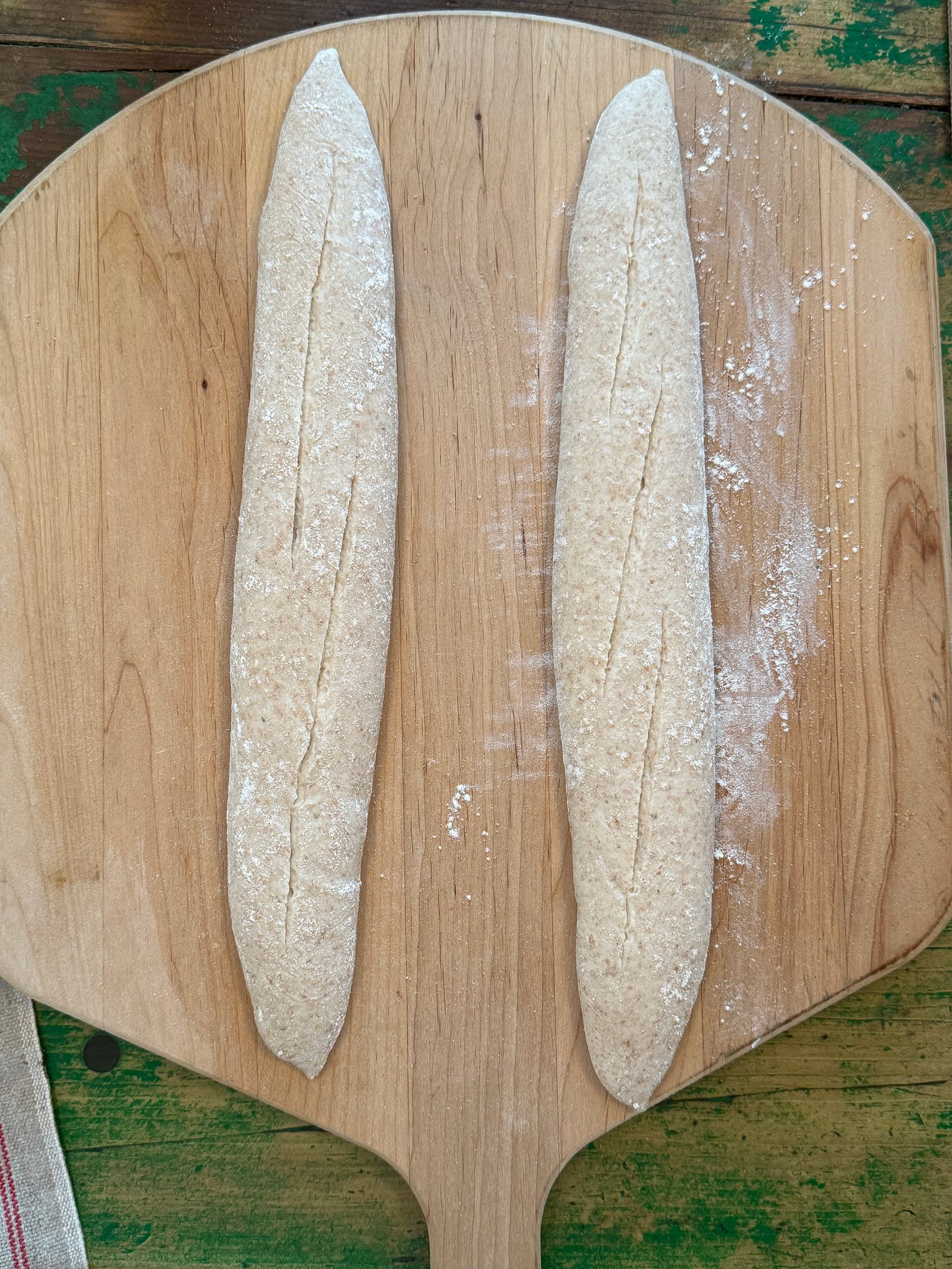
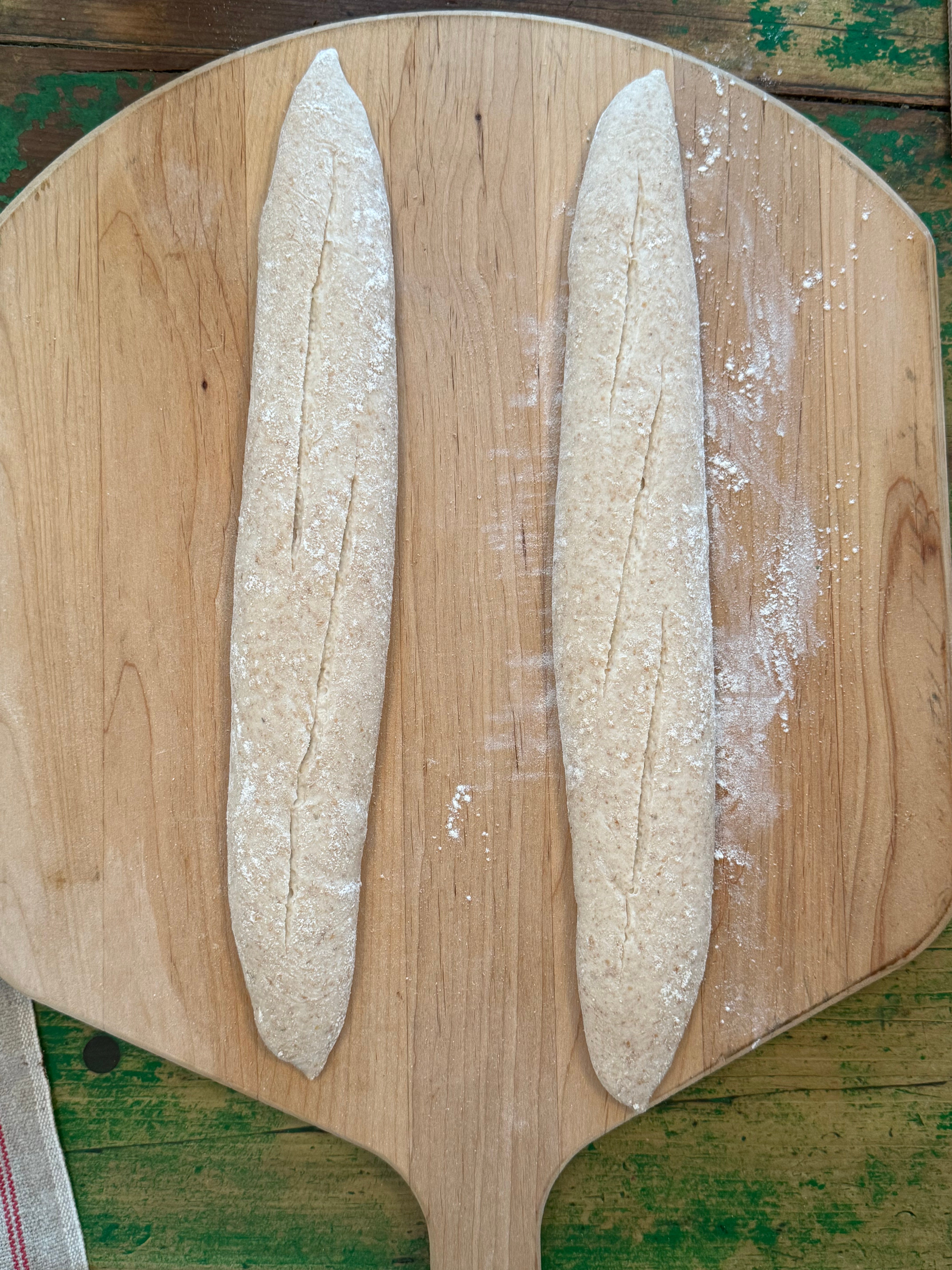
While I’ve almost entirely stopped scoring many of my other loaves, I find a score on a baguette makes a big difference in how it expands during baking, affecting the texture and rise of the whole loaf. I use fresh or pretty new blades to score. Replacements are cheap and you can buy them in bulk. I like one long line down the middle or side best but obviously a classic baguette score is a satisfying thing, and you can try whatever you want. I wouldn’t stress about it - if you do want to go the traditional route, keep in mind that the scores - 2 or 3 or 4 of them on a home-sized loaf - should be not quite straight, angling just slightly from one side of the loaf to the other, and should overlap by about 1/4 of their length, comme ça:
For baking, I lay all my tools on a surface near my oven, which has been preheated with a baking stone and a cast iron or heavy pan on the top rack. I have my lame, which I load with a sharp blade for baguettes. I also have my peel, lined with a piece of parchment (you can also use a cutting board instead of a peel). I have two towels soaking in hot water, which I place in my preheating pan to use for continual steam throughout the bake, and a pair of tongs for transporting them. An oven mitt to do this safely. I have a pyrex measuring cup filled with just-boiled water, which I pour on top of the towels. I have a spray bottle, which I use to generously moisten the entire oven after loading the bread, especially the tops of the loaves. Sometimes I have a roll of tape! Which I use to tape my home-oven shut because it is old and will not do it on its own. I also have a little piece of narrow cardboard that I use to transfer the baguettes from the couche to the parchment-lined peel. Depending on mood sometimes I’ll just freestyle it and use — my bare hands.
This leads me to steam: so important. Your breads should be shiny and bake into a rich brown with a thin crust, they should not be matte or silvery in any way after baking. That means you didn’t have enough steam, and it will give the breads a thicker crust than they deserve, and prevent expansion.
Don’t make your breads too big. I really think homemade baguettes are best scaled to 250g max, but 225g is really nice. Anything longer makes your life harder than it has to be. A demi, flutish baguette at 125g is very sweet also.
Part of what pulls me back into batch after batch is that the mixing process is pretty short compared to other (mostly) sourdough breads. Mix to end of bulk fermentation takes under 2 hours. When you work in a bakery there’s often people who do mixes and people who do the bake-off. I always liked the bake-off shift better, which means I prefer a bread that requires an equivalent or heavier work-load on the baking day, like these do. Regardless of your preference, the mixing day feels like a jaunty sprint in comparison to some doughs that can take the better part of a day to put to rest.
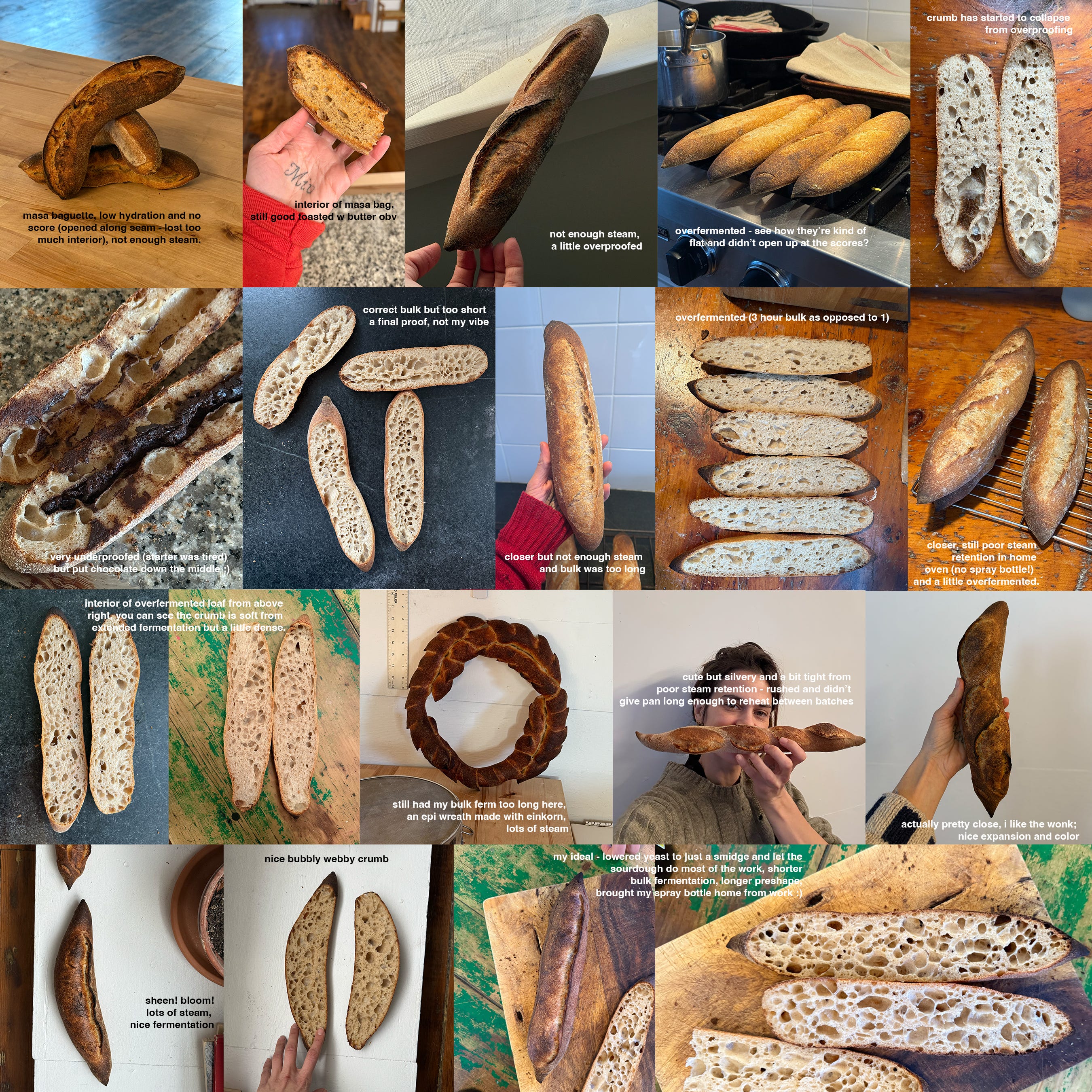
All this and still, baguettes of course do not have to be (and will not be) perfect. For example, as you can see above I still love a wonky shape. When they’re well-made they do provide a lot of opportunity for creative expansion and expression. I definitely recommend fucking up the shaping and adding at least 25% local whole grain flour, or flour that speaks to you in some capacity. This is what I’ve come to see as their potential for bastardization. They’re a form that’s been introduced all over the world by a kind of roving father figure, spreading his seed, so often leaving without much by way of lasting systemic support. So the bastard is subsumed into a way of life reflective of its upbringing, the only one it’s ever known.
Many of the breads the proto-baguette has spawned around the world would not live up to the name under French guidelines. This satisfies me. I encourage the eschewing of guidelines in general, and the addition of things like fats and masa and honey and maple and whatever else might strike you as a fine adjunct to such a global signifier of the exalted, and also the left behind.
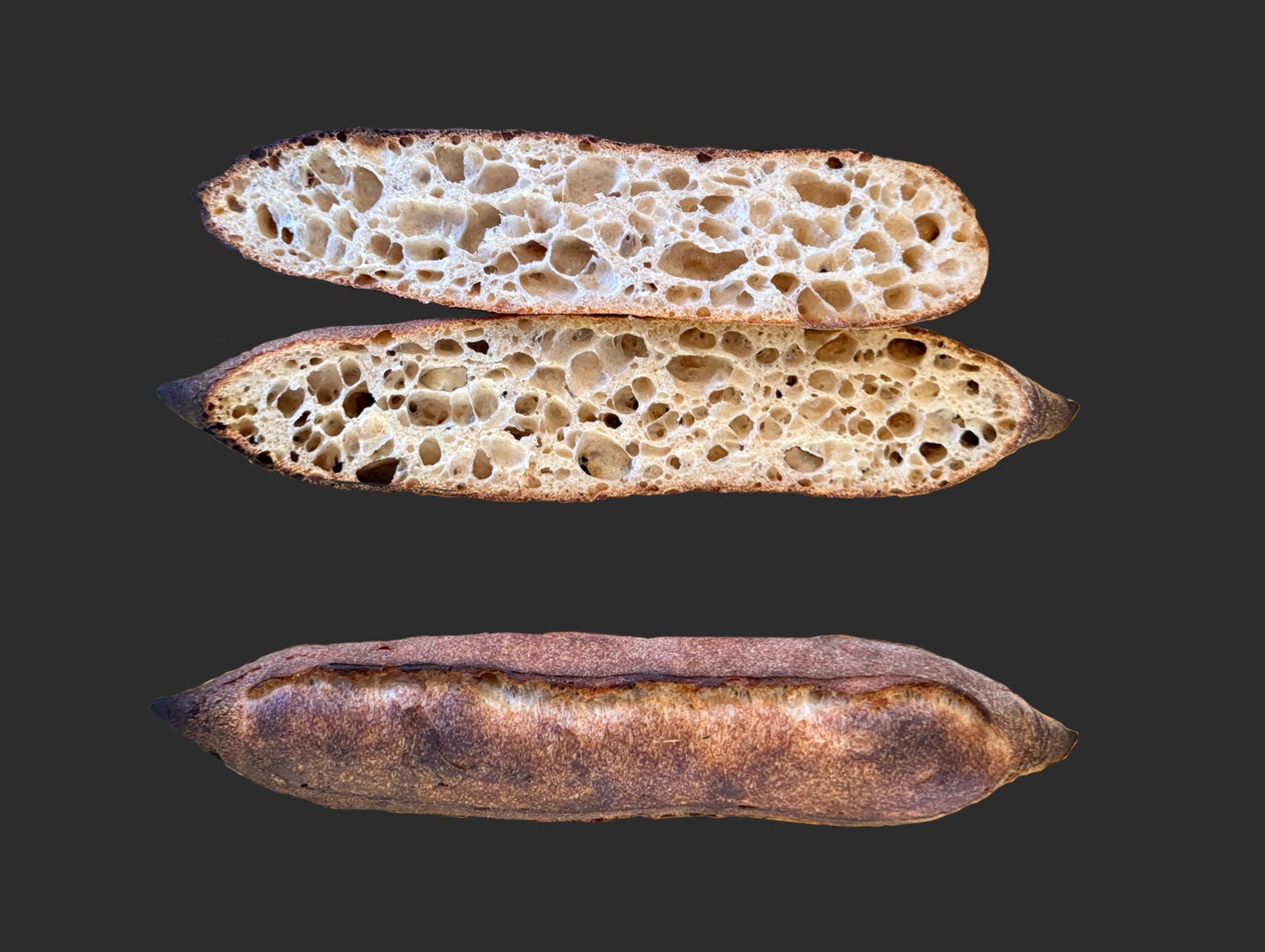
For me it’s about the reveal of what’s happening inside, this druggy moment of suspense. Because unlike with boules, which I find to be hindered by a really open crumb, a baguette has a layer of crust that lines the whole exterior, turning all the holes into little pools. Also enthralling is learning the language of the internal matrix, which can tell you what’s going on with fermentation. The more batches I bake the more I recognize a recurrent crumb structure - honeycombed but with body, its cells wide and round and wild. It’s the result of a series of particular steps, performed in a particular place, with a particular set of ingredients, executed by a particular set of hands. It’s like a signature. So now these baguettes feel like they’re all mine, and I’m keeping them.
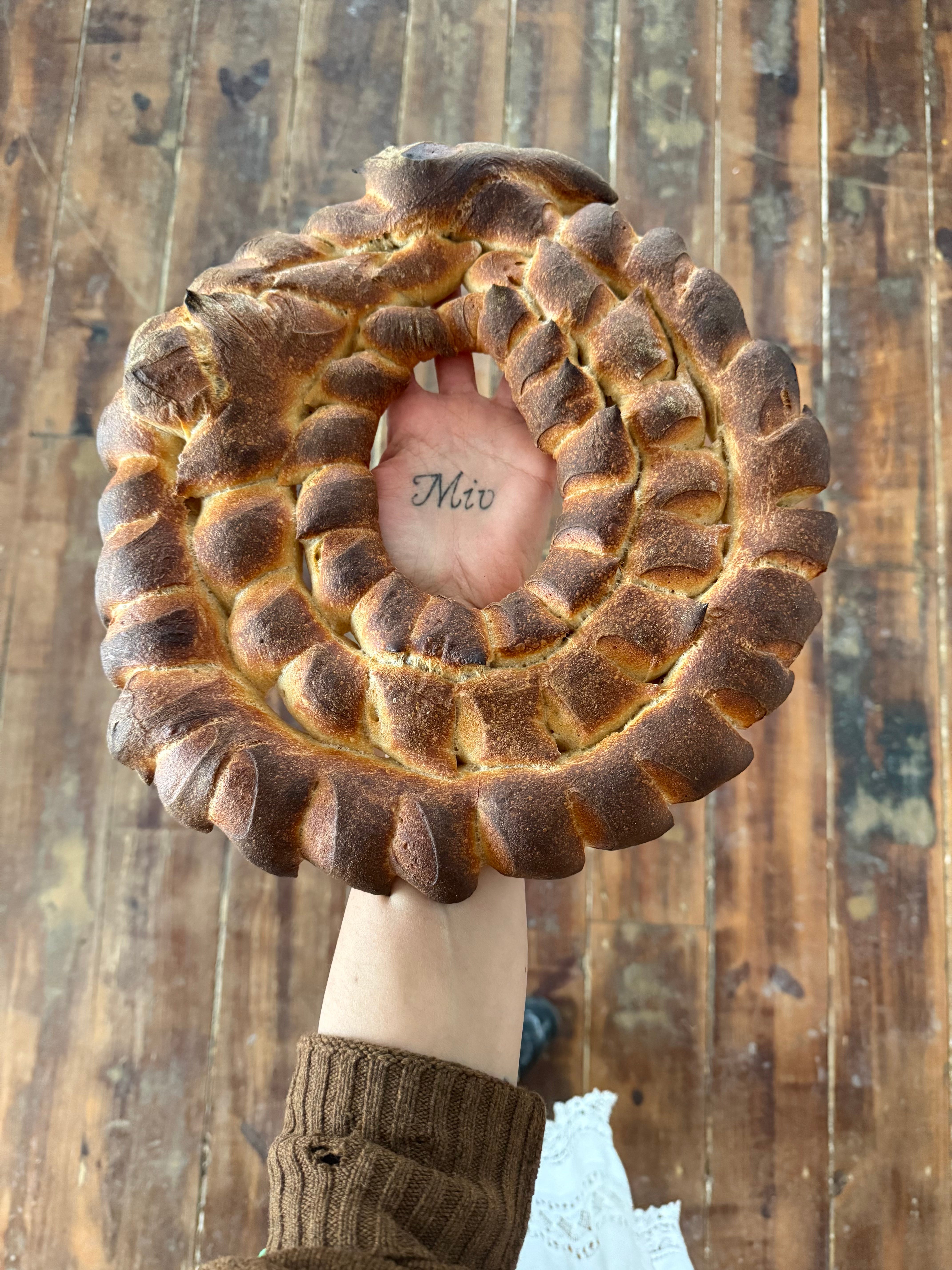
Here’s my mixing and baking process in more detail:
I usually use a mixture of all-purpose, bread flour, and whole wheat flour, all stoneground when possible, and fresh. This is for flavor and enzymatic activity. Use whatever you can find and prioritize recently-milled whole grain flour. The others can be sourced from reputable roller mills if that’s what suits your needs.
I autolyse the dough with the active whole wheat sourdough starter (what some call a fermentolyse, and which I’ve been referring to as ‘fermento’ in my notes, which I think has a nice ring to it). As I mentioned above, I include a tiny bit of instant yeast in my baguette dough, like .09%, if using bread math.
I mix the dough by hand for about 5 minutes. It is pretty strong by the time I’m done but might still tear a tiny bit. I hold back a bunch of the water to add in during the mix, like 10% of total hydration.
After mixing I rest 30 minutes and give it one fold. Then I put it in an oiled container (usually a 2qt cambro with volume measurements on the side) and rest another 30 mins. I mark the side with tape where the top of the dough sits, then I put it in the fridge for at least 18 hours.
By the time I’m ready to shape the dough will have grown by about 50%.
I preshape into little rounds, usually around 250g but sometimes a little smaller and sometimes a little bigger. No flour necessary. I let them rest, covered, for a whole hour.
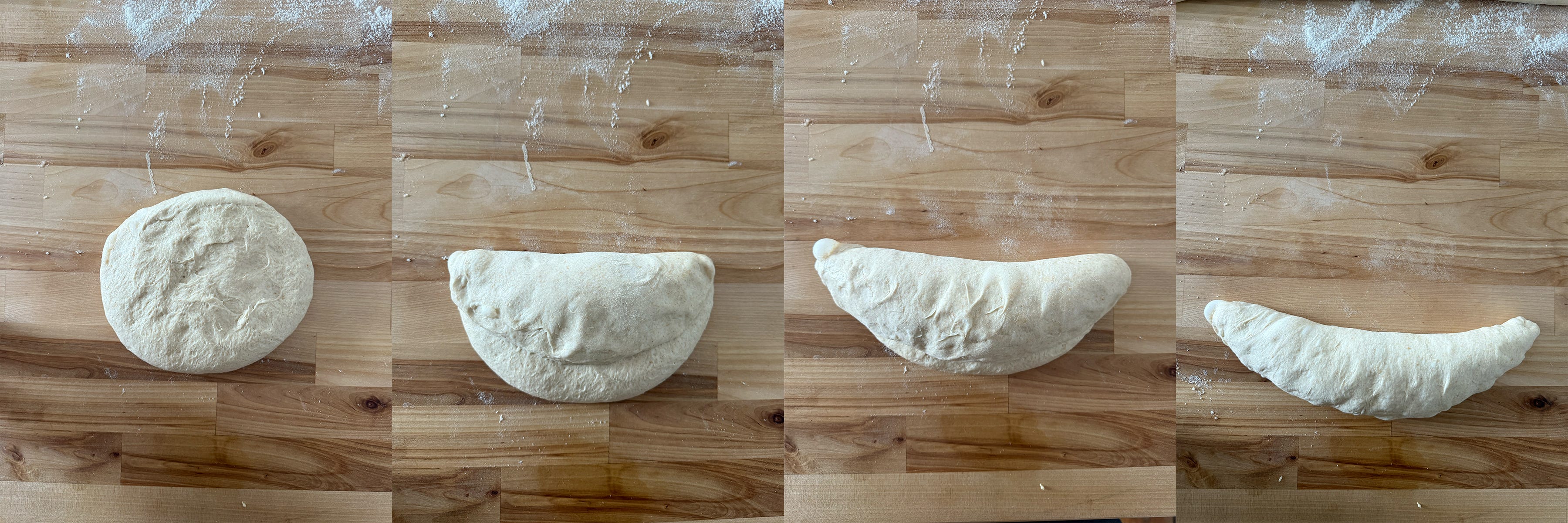
I flour my couche or towels and set them near my workstation on a cutting board or sheet tray. I shape my breads using the notes in number 9, above - a little flour up top, swipe a round through it, fold the top edge down 2/3, fold the newest top edge down just over that, then fold the new newest top edge down and seal along the bottom. It should look like a smile. Swipe through a bit of flour again and roll steadily out towards the ends, focusing on a nice taper and then coming back to the middle to roll out some more and lengthen. This will take some practice - go ahead and watch some videos (I’ll add one to this post soon) but really you just need to do it over and over again. Nestle them side by side in your couche or floured towels. You can cover them with another towel or an inverted sheet tray.
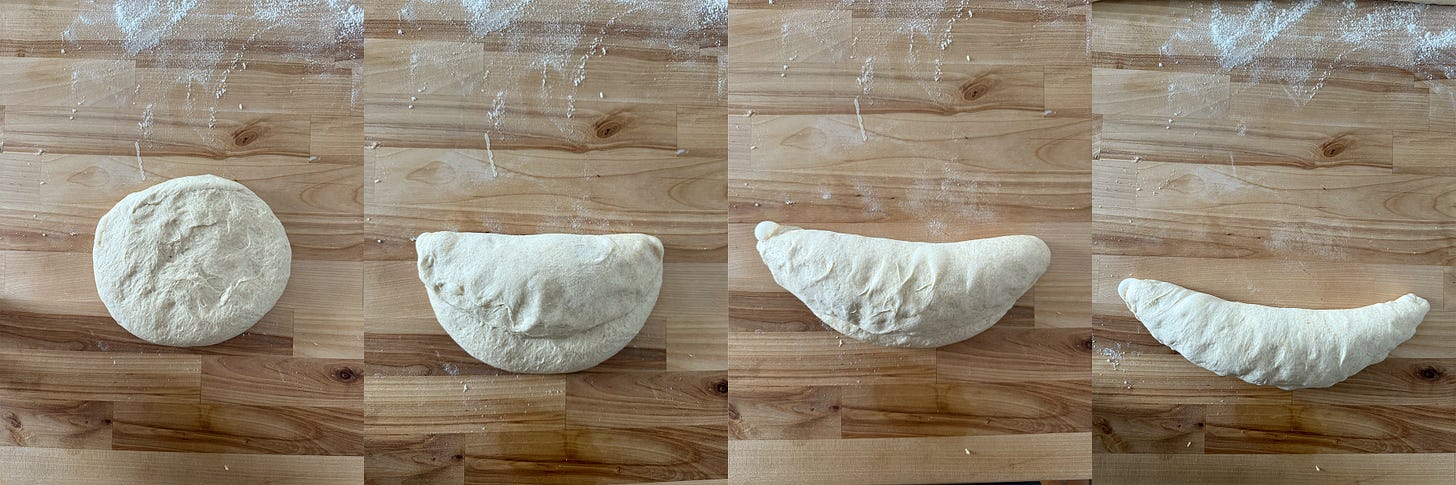
my preferred shaping method (this was actually a monster bag I used for a wreath - over 500g, but you get the idea) 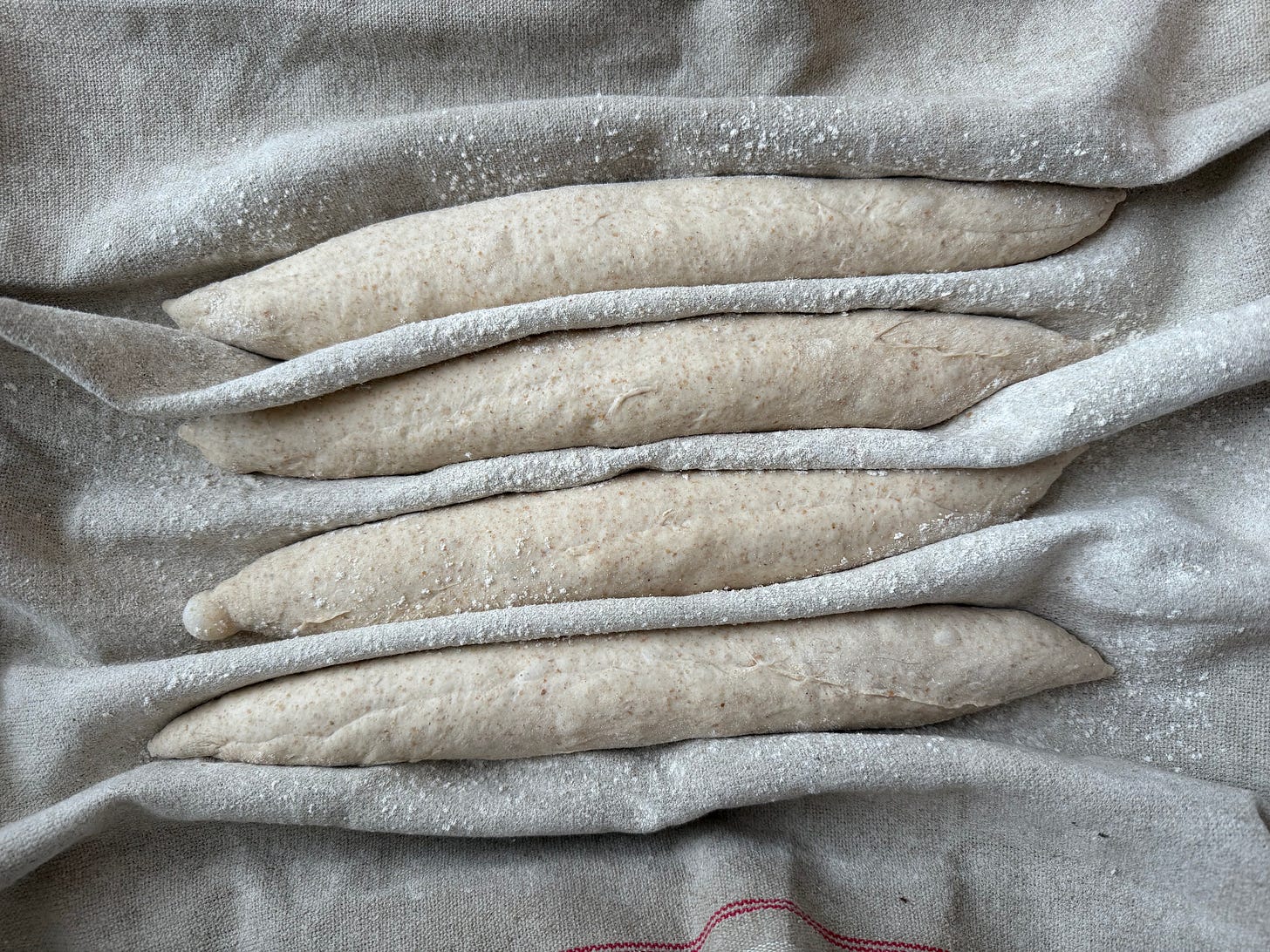
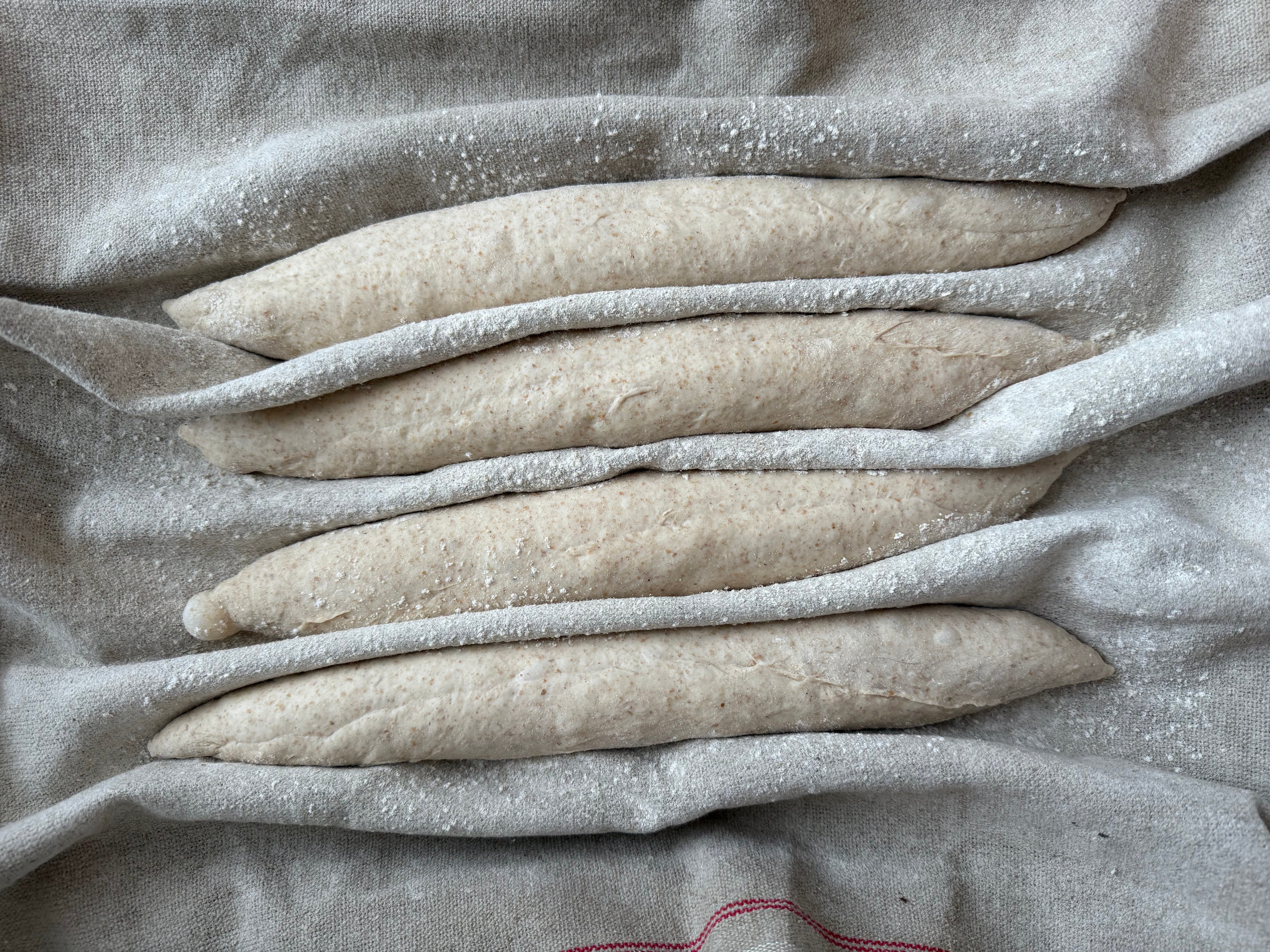
fat boys ready to be tucked in for their brief proof Proof them seam-side up, covered, for just 40 minutes! Then pop them in the fridge for an hour!
Meanwhile get your oven set up - preheat a pizza stone or baking steel, along with a cast iron or heavy duty pan, at 500F. Get all your tools ready as listed in tip number 13, above. When the 1 hour timer goes off you’ll be ready to roll - transfer your breads to the peel (I do 4 at a time) using your hands (!) or a little transfer peel (again, I use a piece of cardboard…), score as you wish, load into the oven, place the towels in the hot pan followed by the boiling water, then spray the shit out of the oven with the spray bottle. If you have an oven that won’t stay shut, like me, do what must be done and tape that puppy closed.
I usually vent the oven (open it for a bit) or just take the steaming apparatus out entirely at around 12 mins. Bake for another 6-8 minutes or until nice and browned. No one likes a pale baguette. If your oven is moving too fast, turn it down to 475F when you take the steam out.
That’s that! I’m saving my exact recipe for the book, but if you want a few more details just message me, I’m bad at keeping secrets.
Luv
Lexie